Which Gas Is Used in Fire Extinguisher? CO2, Nitrogen & Gaseous Agents Explained
Carbon dioxide (CO2) is the primary active suppression gas used in portable gas fire extinguishers throughout India. Because CO2 is a non-combustible gas that is significantly denser than ambient air, it effectively smothers flames by cutting off and displacing oxygen from the local chemical fire triangle. It is stored inside heavy-duty high-pressure cylinders in a compressed liquid phase for rapid deployment.
As leading manufacturers, we specify CO2 fire extinguishers for managing sensitive Class B hazards (flammable liquids like petrol, diesel, and solvents) and Class C hazards (active electrical machinery, server racks, and distribution units). Because CO2 gas is completely clean, dry, and non-conductive, it mitigates electrical shock paths and leaves absolutely zero chemical residue behind. Wholesale prices for industrial-grade models typically range from ₹2,500 to ₹18,000 depending on the cylinder capacity.
Key Properties: Why CO2 Gas is Utilized for Fire Suppression
- Oxygen Displacement: Dilutes local atmospheric oxygen levels below 16% by volume to stop combustion.
- Dielectric Safety: Completely non-conductive and perfectly safe for sensitive live electrical infrastructure.
- Clean Agent Attributes: Evaporates cleanly upon contact, meaning zero chemical residue or post-fire cleanup operations.
- Non-Corrosive Action: Chemically inert compound that will not corrode copper circuitry, metal frames, or concrete finishes.
- High Thermal Expansion: Stored as a liquid under high pressure, expanding into a freezing gas cloud that drops temperatures locally.
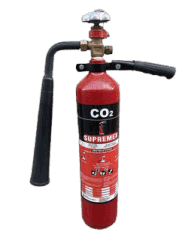
Comparative Guide of Gases Used in Fire Protection Systems
| Gas Type | Chemical Compound | Target Fire Class | Primary Industrial Application |
|---|---|---|---|
| Carbon Dioxide | CO₂ | Class B, Class C | Electrical panels, server rooms, laboratories, commercial fuel centers |
| Nitrogen | N₂ | Class A, B, C (System dependent) | High-pressure propellant in dry powder extinguishers & IG-100 systems |
| Argon | Ar | Class A, B, C | Inert gaseous protection via IG-55 (Argonite) automated installations |
| Inergen (Blended Gas) | N₂ + Ar + CO₂ | Class A, B, C | Total flooding systems inside high-density data banks and museums |
| Halocarbon Clean Agents | HFC-227ea / HFC-125 | Class A, B, C | Clean agent fire extinguishers for medical imagery rooms and telecom hubs |
How a CO2 High-Pressure Extinguisher Smothers Fire
Inside the extinguisher shell, carbon dioxide gas is compressed into its liquid state under an internal pressure of approximately 50 to 60 bar. When you squeeze the discharge mechanism, the liquid rushes up the internal siphon tube and undergoes an intense phase change as it passes through the discharge horn, expanding rapidly back into gas form.
This rapid expansion creates a sub-zero gas cloud that creates a thermal barrier, rapidly dropping temperatures at the root of the flame while creating a heavy blanket that starves the fuel bed of critical oxygen components.
Technical Specifications: Portable CO2 Fire Extinguishers (IS 15683)
| Nominal Agent Capacity | Average Empty Weight | Total Gross Mass (Approx.) | Working Test Pressure | Standard Fire Rating |
|---|---|---|---|---|
| 2 kg Cylinder | 5.1 kg | 7.1 kg | 174 bar (Cylinder Test) | 21B |
| 3 kg Cylinder | 6.8 kg | 9.8 kg | 174 bar (Cylinder Test) | 34B |
| 4.5 kg Cylinder | 11.2 kg | 15.7 kg | 174 bar (Cylinder Test) | 55B |
| 6.5 kg Cylinder | 14.9 kg | 21.4 kg | 174 bar (Cylinder Test) | 78B |
| 9 kg Cylinder | 19.5 kg | 28.5 kg | 174 bar (Cylinder Test) | 89B |
Note: All industrial portable gas models manufactured by Supremex are fully BIS approved and rigorously certified under Indian Standard mandatory compliance rules IS 15683.
CO2 vs Nitrogen: Understanding Propellants vs Agents
A common point of confusion for safety managers is the specific role difference between Nitrogen (N2) and Carbon Dioxide (CO2). Nitrogen is an inert atmosphere gas, but inside portable hand extinguishers, it is strictly used as an invisible, high-pressure propellant gas packed into ABC dry powder or water extinguishers to force the storage media out through the nozzle.
Conversely, CO2 acts as both the propellant and the active extinguishing agent itself. Because it liquefies easily under pressure, it generates its own storage pressure inside the steel housing, removing the need for a secondary gas propellant while working natively to suffocate fire lines.
Frequently Asked Questions (FAQs)
Which gas is used in fire extinguisher units to put out fire?
Carbon dioxide (CO2) is the most globally recognized gas used as a pure extinguishing agent inside portable gas fire extinguishers. CO2 works passively to dilute ambient oxygen concentration beneath 16%, shutting down active Class B fuel vapors and Class C electrical fires without creating short-circuits.
Why is CO2 gas favored over water for electrical system fires?
Unlike water, which conducts electricity and poses extreme shock risks, CO2 is completely non-conductive (dielectric). Additionally, it leaves no damp moisture or chemical salts behind, preventing secondary rust or decay to complex electronics inside network nodes or factories.
What is the mandatory Indian Standard designation for gas fire extinguishers?
In India, portable gas fire extinguishers must be built, tested, and marked in absolute accordance with the national regulatory framework code IS 15683. This supersedes outdated individual standards to establish uniform manufacturing protocols across the safety industry.
Is nitrogen gas ever used to fight fires directly?
Nitrogen is used as a driving force propellant to press powder out of ABC extinguishers. However, in automated built-in industrial piping layouts (such as localized data closets using total flooding configurations), pure nitrogen gas systems (IG-100) are engineered to blanket localized areas during containment breaches.
💰 Get Institutional CO2 Extinguisher Price
Industrial-grade CO2 extinguishers, all capacities. BIS-certified IS 15683 — best wholesale pricing across India.
Related Reading & Products
What Does a Fire Extinguisher Contain
Every extinguishing agent explained, class by class.
CO2 Fire Extinguishers
BIS-certified CO2 extinguishers, 2–9 kg capacities.
CO2 Flooding System
Total flooding CO2 systems for rooms & enclosures.